Basement Wall Painting
We paint basement walls in homes around Exton, from poured concrete and block foundations in newer homes to fieldstone cellars under old farmhouses....
Most epoxy jobs we do around Exton are two-car garages on homes built during the 1990s and 2000s, with slabs that have spent twenty winters soaking up road salt and oil drips. We grind the concrete, test for moisture, and lay down a coating that handles hot tires and dragged-in snow.
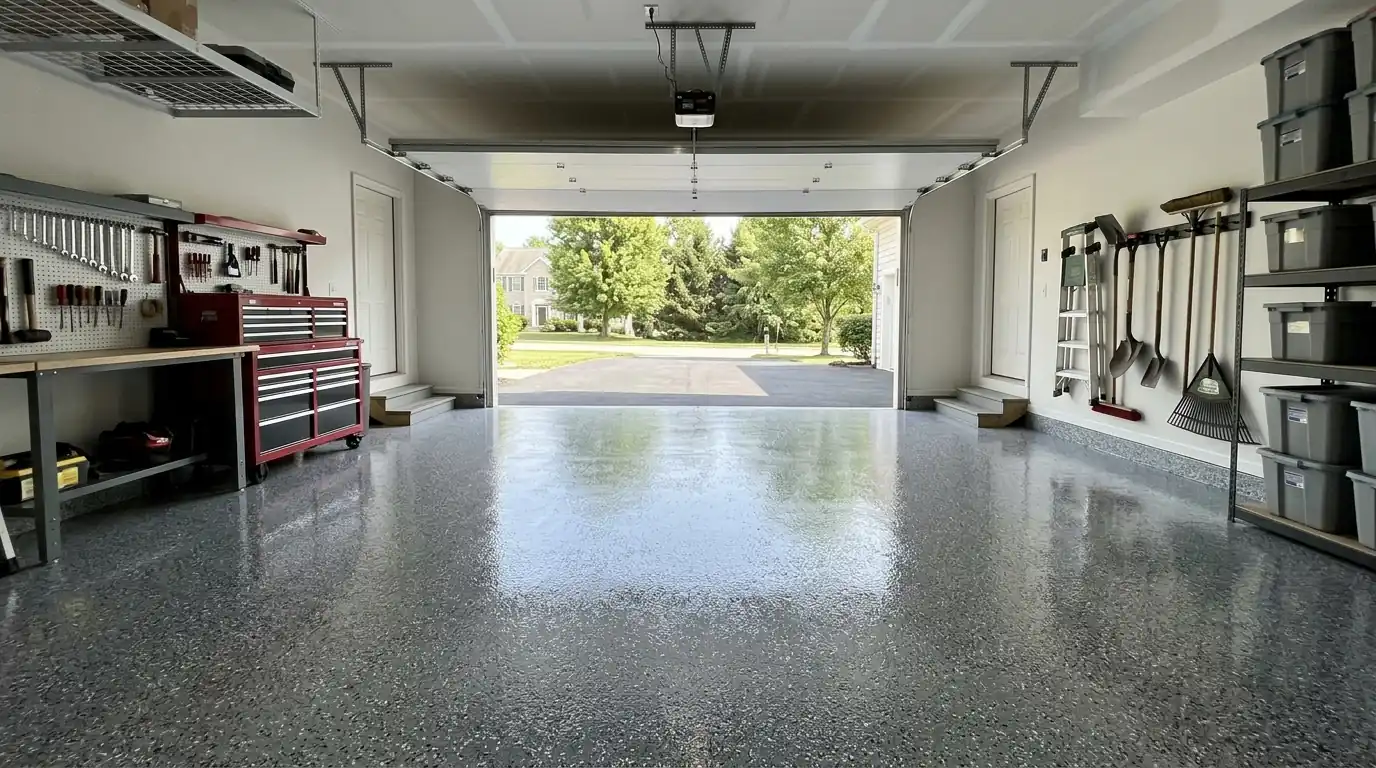
An epoxy floor coating means grinding the concrete open, repairing cracks, rolling an epoxy base coat, broadcasting flake if you want it, and sealing with a clear topcoat. Around Exton and Chester County in 2026, a two-car garage with a flake system typically costs $3,185 to $5,460, and a one-car garage usually runs $1,865 to $3,240, depending on the slab.
Garage floors here take a beating that floors in warmer places never see. From December to March, cars roll in carrying slush laced with road salt, which sits on the slab, dries into a white crust and slowly pits the surface. Freeze-thaw cycles open small cracks near the apron. Hot summer tires lift cheap one-part coatings right off the concrete. A two-part epoxy over a properly ground slab holds up to all of that, and it wipes clean in minutes.
We also coat basement floors, laundry rooms and workshop slabs, plus back rooms in small commercial spaces. Basements need more caution than garages, because moisture moves up through the slab from the ground. In older homes around Downingtown, Phoenixville and Coatesville we always test first, and sometimes the honest answer is a breathable concrete stain on the floor and masonry coatings on the walls rather than epoxy.
A coating only grips as well as the surface under it. Acid etching from a big-box kit leaves residue, misses oil-soaked areas and can't remove an old sealer. We use a walk-behind diamond grinder with a vacuum attached, which opens the concrete pores evenly and strips curing compounds and sealers. The surface ends up with a texture like medium sandpaper. It's louder and slower than etching, but it's the main reason a floor lasts for many years instead of peeling at the tire tracks.
Before pricing a basement, and on any garage that looks damp along the walls, we tape plastic sheets to the slab and leave them for a day or two. Condensation under the plastic or a darkened patch of concrete means vapor is moving up. We also take moisture meter readings around the perimeter. If vapor levels are moderate, a moisture-tolerant primer may solve it. If they're very high, epoxy is the wrong product and we'll say so plainly.
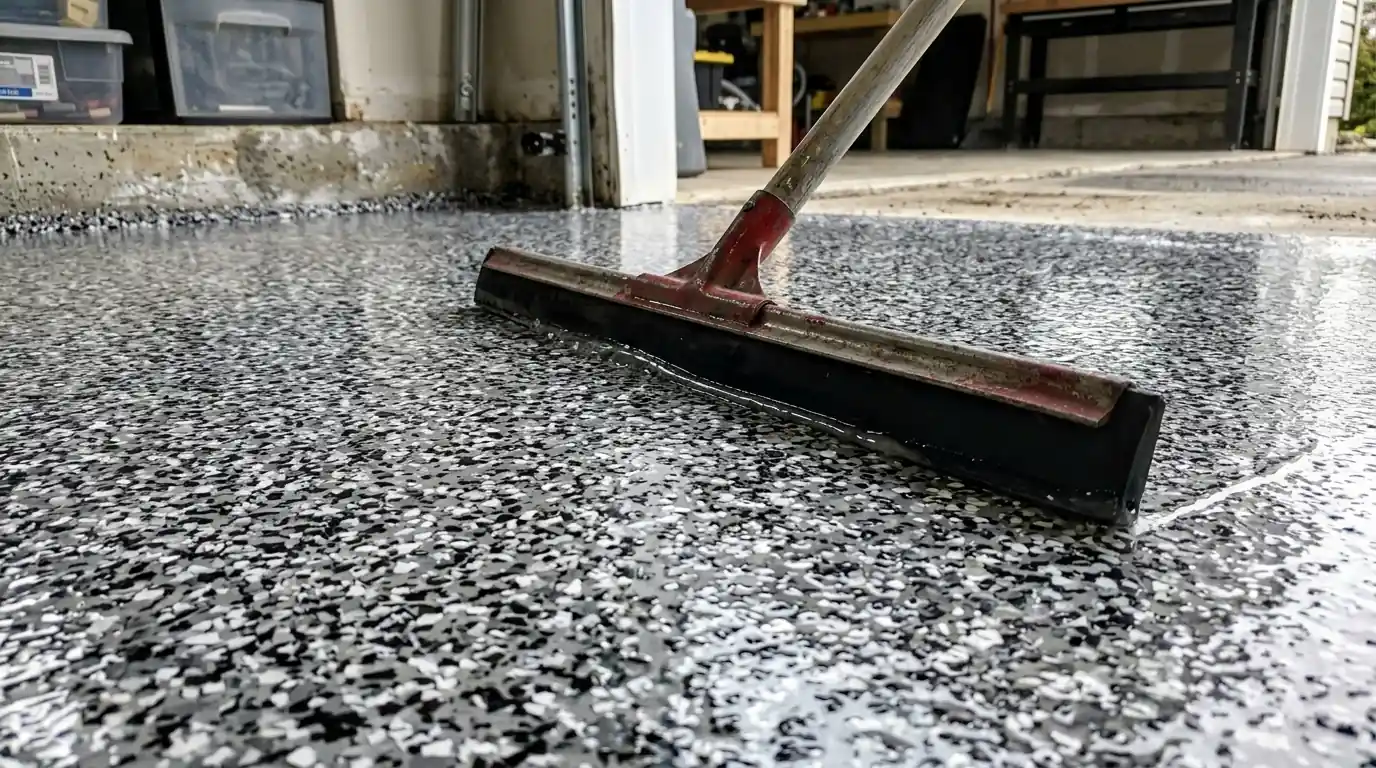
Most garage owners in Chester County choose a full flake broadcast, because the speckled pattern hides salt residue, dust and small tire marks between cleanings. A solid color with a light flake scatter looks cleaner in a workshop but shows dirt sooner. Clear epoxy over ground concrete suits basements going for a modern look. Every system gets a clear topcoat, usually polyaspartic or polyurethane, which resists yellowing in sunlight from an open garage door. We mix a fine grit into that topcoat so wet floors aren't slick.
If the slab shows chalky white rings and rough patches after winter, salt is breaking down the surface, and the damage grows a little every year.
Dark stains that never wash out have soaked deep into bare concrete. Grinding removes most of the surface stain before the coating seals the rest.
Hot tire pickup, flaking along the tire tracks and patches lifting near the door mean a previous coating never gripped the slab properly.
Bare concrete sheds fine dust that gets tracked into the house. A sealed floor stops it and turns sweeping into a quick job.
Hairline cracks, chipped edges at control joints and shallow pits near the apron are easier to fix now than after another winter widens them.
We look at cracks, old coatings and stains, then tape plastic to the slab or use a meter to make sure vapor won't push the new coating off.
You move cars and stored items out. We tape off the bottom of the walls, the door seal and the threshold into the house so grinder dust stays contained.
A diamond grinder with dust collection opens the concrete, removes old sealer and lifts surface stains, then we vacuum until the slab is completely clean.
Cracks are chased open and filled with epoxy or polyurea crack filler, and spalled areas get patched and ground flush with the surrounding concrete surface.
We roll a pigmented epoxy base coat and broadcast flake into it while it's wet, covering the full floor or just a light scatter if you prefer.
After curing, loose flake is scraped and vacuumed, then a clear polyaspartic or polyurethane topcoat with fine grit goes on for grip and UV resistance.
Foot traffic is fine within a day. Parking waits several days, depending on the products and the garage temperature, and we give you the exact date before we leave.
Epoxy pricing depends on the floor area, the condition of the concrete and the system you choose. Grinding off an old coating adds a full step, and heavy crack repair adds material and time. Flake systems cost more than a solid color because of the extra broadcast and scraping. These 2026 ranges are typical for garages and basements around Exton and Chester County, and every price is confirmed after we test the slab.
| Job | Typical range |
|---|---|
| One-car garage, flake system | $1,865 to $3,240 |
| Two-car garage, flake system | $3,185 to $5,460 |
| Three-car garage, flake system | $4,465 to $7,380 |
| Basement floor, solid color, about 450 sq ft | $1,945 to $3,615 |
| Old coating removal by grinding, two-car garage | $645 to $1,380 |
| Crack and spall repair, typical garage | $265 to $735 |
Planning ranges for 2026, not quotes. The written price comes from a walkthrough. See every service side by side on the painting costs page.
We take on epoxy floor coating in these towns across Chester, Delaware, Montgomery and Bucks counties. ZIP codes shown for each.
Foot traffic is usually fine the next day. Cars should wait several days so the coating reaches full hardness, and a cold garage in late fall slows that down. We give you a specific parking date based on the products used and the temperature during the cure.
A smooth glossy coating can be, especially with snowmelt dripping off a car. That's why we add a fine anti-slip grit to the topcoat, and why flake systems feel grippier underfoot. If you want more texture near the door into the house, we can increase the grit in that strip.
Salt won't eat through a cured epoxy and polyaspartic system the way it pits bare concrete. Brine left sitting for weeks can dull the topcoat's gloss, so rinsing the floor a few times through winter and squeegeeing meltwater out the door keeps it looking new.
Only after testing. If occasional dampness comes from a leak or a dryer vent, that gets fixed first. If vapor is rising through the slab, a moisture-tolerant primer may handle it. For floors with high vapor or actual water entry, epoxy will fail, and a breathable stain is the safer choice.
On a ground and properly primed slab with a quality topcoat, many floors look good for well over a decade with normal car traffic. The topcoat may need a fresh layer in the tire lanes after years of use, which costs far less than redoing the whole system.
New concrete has to cure for about four weeks before coating so moisture can escape. For slabs with radiant tubing, we grind carefully and avoid deep crack chasing near the tubes. Tell us about in-floor heat during the walkthrough so we can plan the grind depth.
We paint basement walls in homes around Exton, from poured concrete and block foundations in newer homes to fieldstone cellars under old farmhouses....
On many homes around Exton and West Chester, the garage doors are wider than the front porch, and on a three-car colonial they can be the largest...
Wraparound farmhouse porches, borough front porches and the concrete stoops of 1950s colonials all wear out underfoot first. We sand or grind back to...
Few businesses around Exton can shut down for a week while the walls get painted. We schedule commercial work in evening, overnight and weekend...
Green streaks on the north side of a vinyl-sided house, black mildew on a cedar deck, a gray film on fieldstone: Chester County's humid summers grow...
Call any time. We will ask a few questions and set up a walkthrough at your home.