Window & Sash Painting
Original wood windows in Chester County farmhouses and borough homes can last another century if paint and glazing keep the water out. We scrape,...
Rot on Chester County homes tends to start where water sits: window sills on old farmhouses, porch post bases, the bottoms of door jambs and trim on 1990s houses built with finger-jointed boards. We cut decay back to sound wood, rebuild with epoxy or new lumber, and prime before the weather gets in.
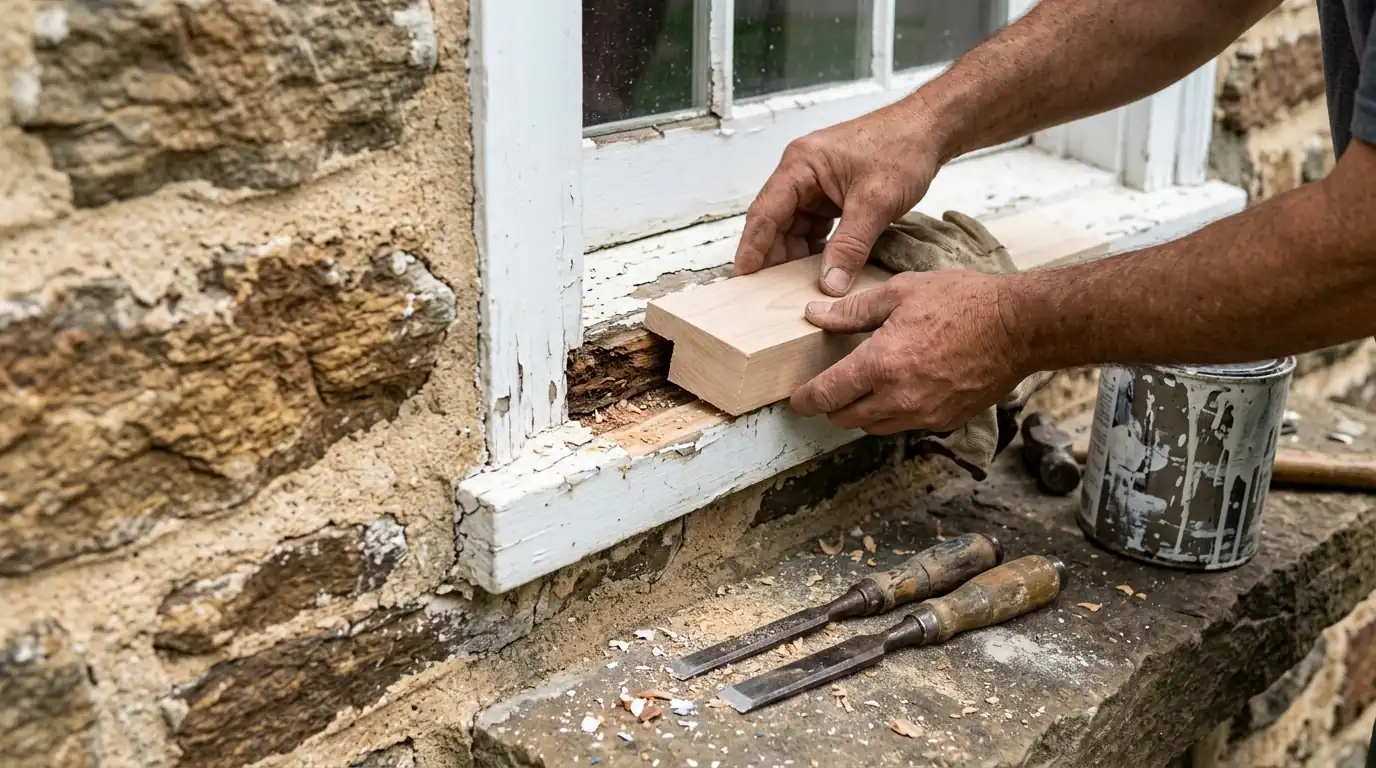
Wood rot repair means removing soft, decayed wood back to solid fibers, then either hardening and filling the area with two-part epoxy or fitting a new piece of matching wood. Every repair gets primed right away and painted with the house. Around Exton, a single sill repair usually runs $295 to $665, and a rebuilt porch post base $615 to $1,385.
Freeze-thaw winters and humid summers are hard on painted wood. Water gets in at an open joint or a cracked caulk line, the wood stays damp, and rot spreads under paint that still looks fine from the yard. By the time a sill feels soft under your thumb, the damage often runs a few inches past what you can see. That's why we probe every suspect spot with an awl before deciding on a repair.
We handle rot as part of painting because the two can't be separated. Paint over soft wood fails within a season or two, and new wood left unprimed starts soaking up water right away. Most of our rot repairs happen during prep for exterior painting or window and sash work, though we also take on smaller standalone repairs between paint cycles.
For small to medium rot, we use a two-part epoxy system. A thin liquid consolidant soaks into the remaining wood fibers and hardens them, then an epoxy filler rebuilds the missing shape and gets sanded to match the profile. Epoxy works well on molded sills, carved trim and the corners of window frames, where saving original wood matters, and it takes paint just like the wood around it.
When rot runs deep or covers a long stretch, we cut it out and fit a new piece, called a Dutchman, glued and fastened in place. On 1990s and 2000s homes, where trim boards are often finger-jointed pine, we may replace a whole board with cellular PVC or primed solid wood instead, since patching soft pine rarely lasts more than a few winters.
On older stone farmhouses and borough twins, we find rot most often at window sills, the bottoms of door frames, porch post bases and the ends of porch floor boards. On newer homes, it shows up at garage door jambs, trim along the bottom of siding, and corners where roof runoff splashes back. Bank barns and outbuildings add sill plates and door tracks. Each spot shares one trait: water lands there and has no quick way to drain or dry.
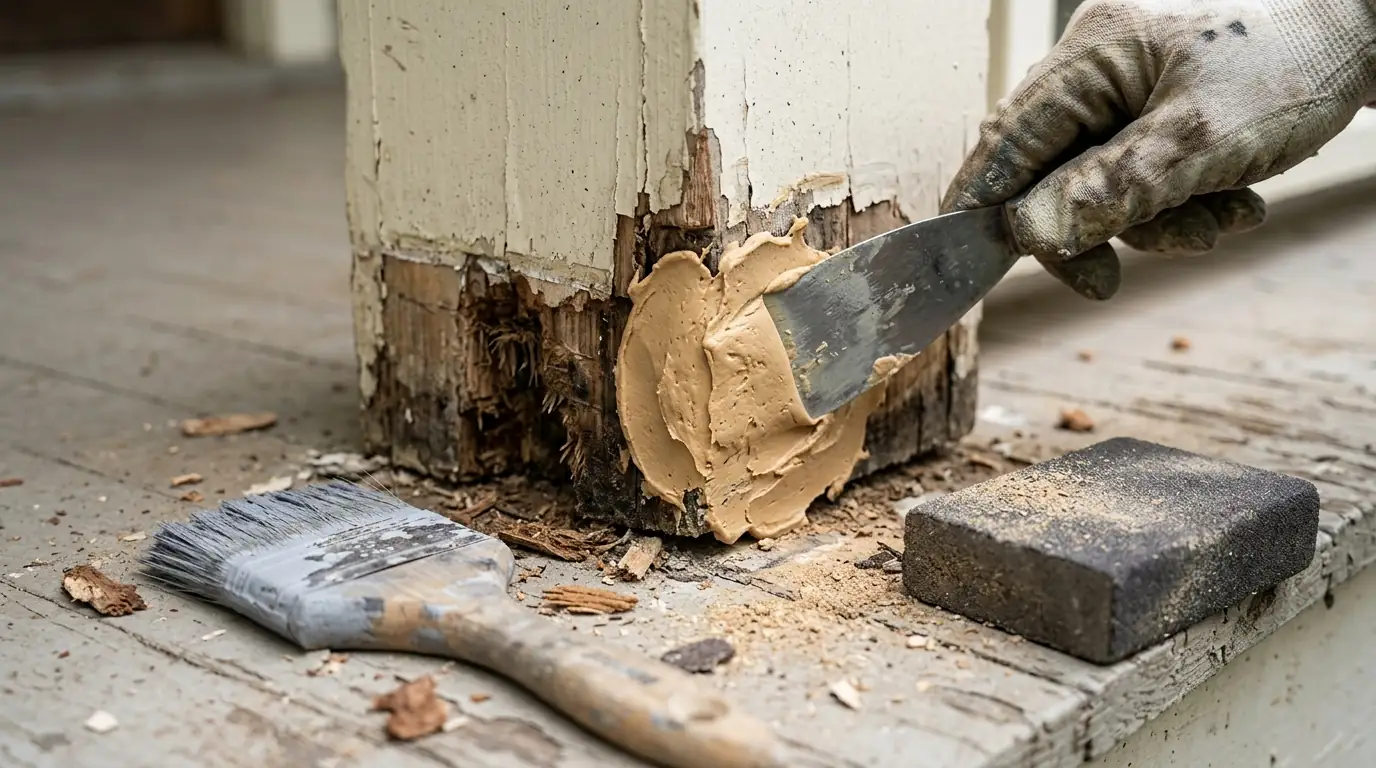
Fresh epoxy, new wood and freshly cut end grain all need sealing fast. We prime every repaired area the same day or the next, paying extra attention to end grain, which drinks water like a straw. Joints between old and new wood get a flexible sealant. Then the repair is painted with the rest of the house, so it blends in and stays sealed through winter. Our post on why exterior paint peels shows how often failed paint starts at an unsealed joint.
Press the bottom of a sill or door jamb. If it gives or feels spongy, rot is already inside, even when the paint still looks intact.
Paint that splits along a seam lets water in, and rot often starts right there. It's an early warning worth catching before winter.
Gray or black staining at the cut ends of trim and porch boards shows wood that stays wet. Rot usually follows within a few years.
A post that moves when pushed may have a rotted base or plinth. That's a structural concern, and it should get attention soon.
Fungus growth, or wood that crumbles into small cubes, means advanced decay. The damaged piece likely needs cutting out rather than filling.
Gaps where trim meets the frame let wind-driven rain in during storms. Sealing them now keeps rot from starting behind the paint.
We probe suspect wood with an awl, mark the edges of the rot, and show you each spot so you know the extent before any cutting begins.
Soft wood is removed with chisels and oscillating saws until only firm fibers remain. Leaving rot behind is the most common reason a repair fails again.
The opened area dries out, then gets a liquid consolidant that soaks into the remaining fibers and hardens them so the filler has a solid base.
Epoxy filler rebuilds smaller voids and is shaped to the original profile. Larger losses get a fitted Dutchman or a replacement board, glued and fastened.
We sand the repair flush, prime it along with any exposed end grain, and seal the joints between old and new material with a flexible sealant.
The repaired areas are painted to match, and we walk you around each one so you can see what was fixed and what to watch going forward.
Rot repair is priced by the spot, because each one depends on how far the decay goes and whether epoxy or new wood suits it. Ladder height, ornate profiles and how much original wood you'd like saved all play a part. These are typical 2026 ranges for homes around Exton and Chester County, and we confirm them after probing each spot.
| Job | Typical range |
|---|---|
| Single window sill, epoxy repair | $295 to $665 |
| Door jamb bottoms, both sides | $365 to $745 |
| Dutchman patch on a long sill | $435 to $915 |
| Porch post base rebuild | $615 to $1,385 |
| Fascia or rake board section, second story | $545 to $1,215 |
| Bank barn door frame or sill plate section | $865 to $1,935 |
Planning ranges for 2026, not quotes. The written price comes from a walkthrough. See every service side by side on the painting costs page.
We take on wood rot repair in these towns across Chester, Delaware, Montgomery and Bucks counties. ZIP codes shown for each.
Often, yes, as long as the rot hasn't eaten through most of the piece. Epoxy consolidant hardens the remaining fibers, and filler rebuilds what's missing. If more than about half the board is gone, a new piece is usually the sounder choice, and we'll tell you which applies.
A well-done epoxy repair, primed and kept painted, can last as long as the wood around it. Epoxy itself doesn't rot. What fails is usually the surrounding paint or caulk, so keeping the repair sealed is what keeps it sound.
On flat trim and sills, a properly sanded repair is very hard to spot once painted. On wood with a heavy grain or a carved profile, you might notice a slight difference up close. From the yard, it disappears.
Epoxy needs warmth to cure, usually above 50 degrees or so, and primer needs similar conditions. Interior rot and protected spots like porch ceilings can be done in colder months with some heat, but most exterior repairs wait for spring.
Many homes built in the 1990s and 2000s used finger-jointed pine trim, which soaks up water at its joints and ends. Once the paint cracks, rot follows quickly. Replacing failed boards with cellular PVC or solid primed wood usually stops the cycle.
Always. Painting over soft wood traps moisture and hides damage that keeps spreading. We repair rot during prep, so the new paint goes onto solid, primed wood and the fix is protected from day one. It also means you only pay for ladders and setup once.
Original wood windows in Chester County farmhouses and borough homes can last another century if paint and glazing keep the water out. We scrape,...
Wraparound farmhouse porches, borough front porches and the concrete stoops of 1950s colonials all wear out underfoot first. We sand or grind back to...
We repaint the outside of homes around Exton, from fieldstone farmhouses with wood trim to 1990s colonials wrapped in cedar, stucco and vinyl. Every...
Chester County has an unusual number of old houses: fieldstone farmhouses, bank barns, Federal and Victorian homes along borough streets in West...
Bank barns, carriage houses, wood sheds and detached garages are part of what makes Chester County properties look the way they do. We scrape them...
Call any time. We will ask a few questions and set up a walkthrough at your home.