Exterior House Painting
We repaint the outside of homes around Exton, from fieldstone farmhouses with wood trim to 1990s colonials wrapped in cedar, stucco and vinyl. Every...
Stucco around Chester County comes in two kinds: old lime stucco over farmhouse stone and newer stucco on 1990s and 2000s homes. The newer kind can hide wet, rotting sheathing behind a face that looks fine. We check moisture before painting either one, then fill cracks and choose a coating that suits the wall.
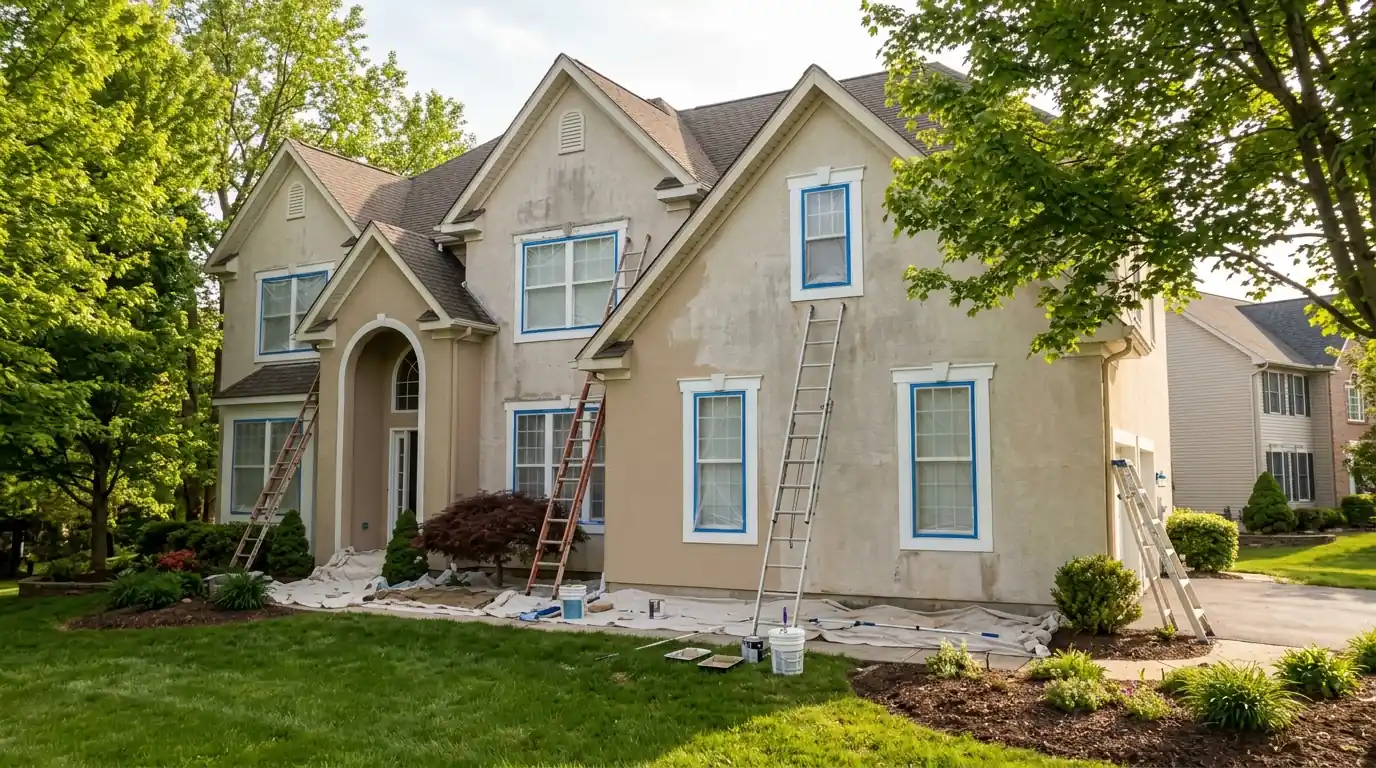
Stucco painting starts with moisture readings where water usually gets in, then washing, filling cracks, priming patches and two coats of breathable masonry paint worked into the texture. Around Exton and Chester County, repainting the stucco on a two-story single usually runs $6,840 to $13,960. A stuccoed farmhouse addition or garage runs about $1,380 to $3,270.
Stucco homes built across southeastern Pennsylvania in the 1990s and early 2000s have a well-known problem. Many were installed without proper flashing at windows and roof lines, or without a working drainage gap behind the stucco. Rain gets in, can't get out, and the wood sheathing behind it slowly rots while the outside still looks solid. Painting over that hides the evidence without fixing anything, which is why we never start with the brush.
Older stucco is a different material. Many farmhouses and borough homes have lime-based stucco over stone or brick, sometimes original and sometimes added a century ago. It's hard and durable but has usually been painted and patched several times. That wall needs a coating that lets moisture move out through it, not a thick film that holds water against the stone.
On a 1990s or 2000s stucco home, we take moisture meter readings below window corners, beside roof lines and doors, along the bottom edge and wherever a deck meets the wall. We look for kick-out flashing where a roof ends against stucco, for sealant gaps around windows and for stains or cracks fanning out from corners. High readings or soft spots mean the wall needs a closer look before it gets paint.
In that case we'll recommend probe testing by a stucco inspector, which uses small drilled holes to read moisture at the sheathing. If the wall is wet inside, remediation comes first and painting comes after. If it's dry and sound, we go ahead with confidence. Our post on why moisture comes first on stucco covers this in more depth.
Fine map cracking across a wall is common and mostly cosmetic, and primer plus two good coats usually hide it. Cracks that open wider each winter, especially diagonal ones off window and door corners, are moving and letting water in. We open those slightly and fill them with flexible masonry sealant before priming. Hollow spots that sound dull when tapped mean the stucco has let go of its backing, and that's a repair for a plasterer, not a painter.
Elastomeric coatings are thick and stretch over small cracks, which helps on stucco over concrete block. On wood-framed stucco homes and on old stucco over stone, that heavy film can slow drying and trap moisture inside the wall, the exact problem these houses already risk. For those walls we usually choose a breathable masonry acrylic or a mineral paint and handle moving cracks one by one. On older farmhouse stucco, we keep paint strictly off any exposed fieldstone.
North-facing stucco under mature trees stays damp and grows dark mildew deep in the texture. Paint over mildew fails fast. We treat the wall with a mildewcide wash and rinse at low pressure, because a hard spray can erode the surface and push water into the very cracks we're worried about. The wall then dries through at least two sunny days before patching starts, and we recheck moisture before priming.
Dark streaks or cracks spreading diagonally from window corners are a classic sign of water getting behind stucco, and they call for moisture checks first.
Cracks you can slide a card into let rain behind the surface and must be opened and filled before any new coat will hold.
Stucco that gives when pressed or bulges outward may have lost its backing or sit on wet sheathing. That needs inspection before paint.
Old repairs in different colors and textures make a wall look tired, and priming and painting together can blend them into one surface.
Mildew and algae in the texture of shaded walls hold moisture against the stucco and need killing and rinsing before any painting.
Brushing against the wall and coming away white means the old coating has weathered out and no longer sheds water the way it did.
We take meter readings at the high-risk spots, tap for hollow areas, map cracks and check flashing. Worrying results get a recommendation for probe testing before we go further.
A mildewcide wash and low-pressure rinse clear dirt and growth from the texture, then the wall dries fully before any patching or primer.
Active cracks are opened slightly and filled with flexible masonry sealant. Small dings and holes get a masonry patch textured to match the wall.
Failed sealant at windows, doors and pipe penetrations is cut out and replaced so the joints where water usually gets in are tight again.
A masonry primer seals patches and bare spots so the finish dries to one even color instead of flashing over each repair.
We roll with a thick-nap cover and back-brush so paint fills every pocket in the texture, leaving no pinholes for water to enter.
Stucco takes more paint than smooth siding because the texture holds extra material, and crack and sealant work adds labor. These 2026 ranges reflect homes around Exton and Chester County, and they assume the wall passed a moisture check. Probe testing by a stucco inspector and any remediation are separate from painting and come first when needed.
| Job | Typical range |
|---|---|
| Two-story stucco single, full repaint | $6,840 to $13,960 |
| Large 2000s stucco home with tall gables | $11,370 to $19,840 |
| Farmhouse stucco addition or garage | $1,380 to $3,270 |
| Crack filling and window sealant, typical house | $485 to $1,460 |
| Mildew treatment and low-pressure wash | $335 to $815 |
Planning ranges for 2026, not quotes. The written price comes from a walkthrough. See every service side by side on the painting costs page.
We take on stucco painting in these towns across Chester, Delaware, Montgomery and Bucks counties. ZIP codes shown for each.
No. Paint can make the outside look sound while the sheathing behind it keeps rotting. That's why we check moisture first on newer stucco homes. If readings are high, the wall needs probe testing and repair before paint. Painting a dry, sound wall is fine and helps protect it.
No. We take surface moisture readings and look for the warning signs. Probe testing involves drilling small holes into the wall and reading moisture at the sheathing, and it's done by a stucco inspector. We'll tell you plainly when our findings mean you should arrange one.
Stucco holds cold longer than wood, so the wall may be well below air temperature on an October morning. We read the surface temperature, not just the forecast, and usually paint stucco between late April and mid-October here. Late jobs move to spring rather than risk a coating that never cures properly.
Integral-color stucco that's clean and sound can be left alone. If it's stained, patched in odd colors or crazed with fine cracks, a breathable masonry paint renews it. Once painted, it will need repainting every eight to twelve years, so we explain that tradeoff before you commit.
On farmhouses where stucco meets exposed stone, we hand-cut that line with a brush and mask stone sills and window wells. Drips on porous stone are hard to remove cleanly, so we spend the extra time on masking rather than trying to clean up mistakes later.
We repaint the outside of homes around Exton, from fieldstone farmhouses with wood trim to 1990s colonials wrapped in cedar, stucco and vinyl. Every...
Green streaks on the north side of a vinyl-sided house, black mildew on a cedar deck, a gray film on fieldstone: Chester County's humid summers grow...
Chester County has an unusual number of old houses: fieldstone farmhouses, bank barns, Federal and Victorian homes along borough streets in West...
Brick around Chester County ranges from soft 19th century brick in the borough rows of West Chester and Phoenixville to the veneer fronts on 1990s...
Rot on Chester County homes tends to start where water sits: window sills on old farmhouses, porch post bases, the bottoms of door jambs and trim on...
Call any time. We will ask a few questions and set up a walkthrough at your home.