Front Door Painting
Your front door gets touched, kicked and baked in afternoon sun more than any other painted surface on the house. We take the hardware off, fix the...
Iron railings on borough stoops, Victorian porches and 1960s ranch entries all fail the same way: rust starts at a chip, creeps under the paint and lifts it in blisters. We take that rust back to sound metal, prime it right away, and finish with a hard exterior enamel.
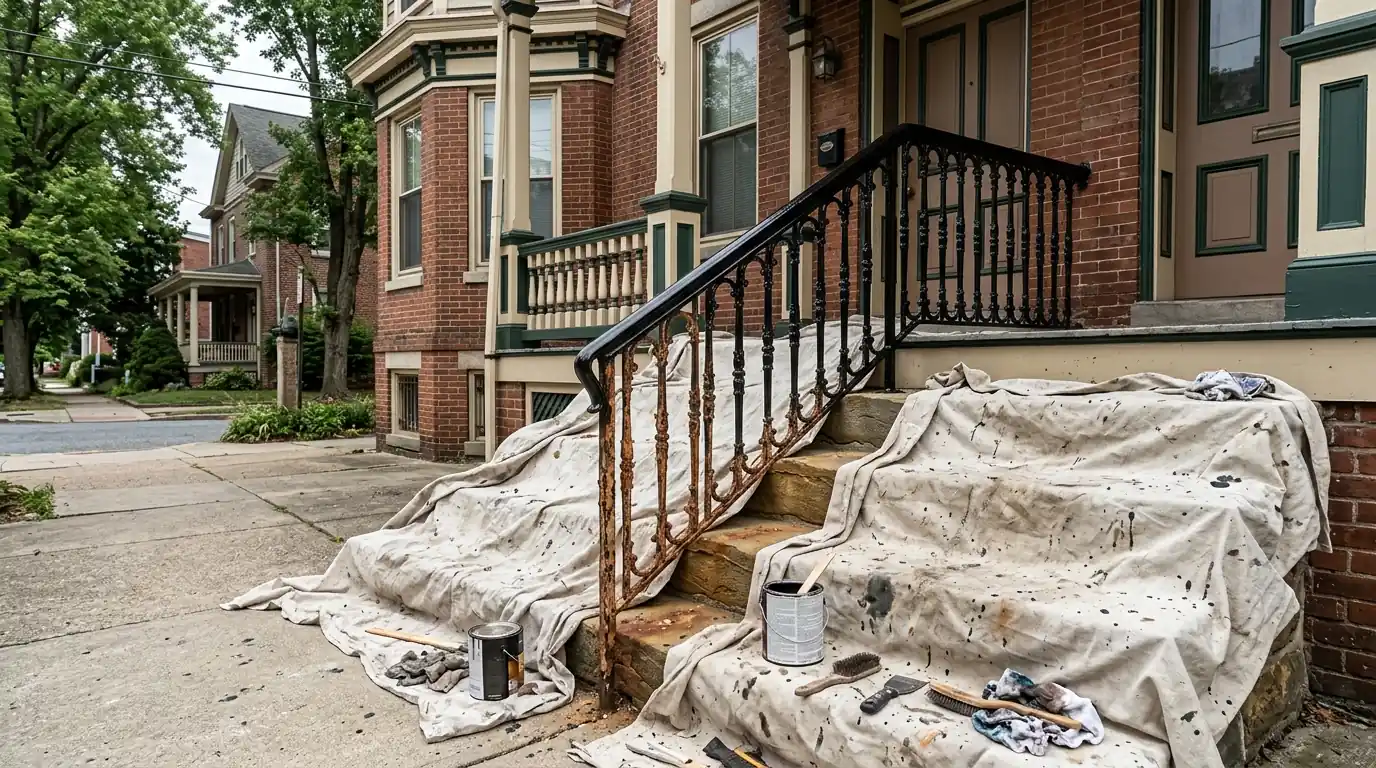
Railing painting means hand and power wire-brushing rust and loose paint, washing off road salt, priming bare iron the same day, then brushing two coats of exterior metal enamel. Around Exton and Chester County, a pair of stoop railings typically costs $395 to $845, porch railing runs about $29 to $54 per linear foot, and ornate cast iron costs more.
Walk any older street in Phoenixville, Pottstown or Coatesville and you'll see iron along the stoops and porches, some of it original and some added decades later. Out in the townships, many 1950s and 1960s ranches and split-levels have scrolled iron porch columns and short railings beside the front steps. Newer homes and townhomes often have galvanized or powder-coated steel. All of it takes the same beating from winter salt, freeze-thaw cycles and humid summers.
A coat of black paint brushed over rust looks fine for one season. Then the rust underneath keeps growing, the paint bubbles at the post bases and bottom rail, and you're back where you started with more layers to remove. We'd rather spend the time on removal and priming, because that's what decides whether your railing goes five years or two between coats.
Straight pickets go quickly with wire wheels and flap discs. Twisted balusters, cast rosettes and scrolls on borough porch railings take hand tools, small wire brushes and patience. The aim is metal with no loose rust or flaking paint, even if tight dark staining stays in the pits. Old railing coatings often contain lead, so we mist before scraping, lay tarps over steps and plantings, and collect every chip rather than letting it fall into the garden.
Many railings on 1990s and 2000s homes and HOA townhomes are hot-dipped galvanized steel. Zinc reacts badly with ordinary alkyd primers, and paint can peel off in long strips within a year or two. We degrease galvanized metal, scuff it, and use a primer made for galvanized surfaces. Powder-coated railings need their own approach: we sand the gloss, spot prime chips down to bare steel, and topcoat with an enamel that bonds to the old coating.
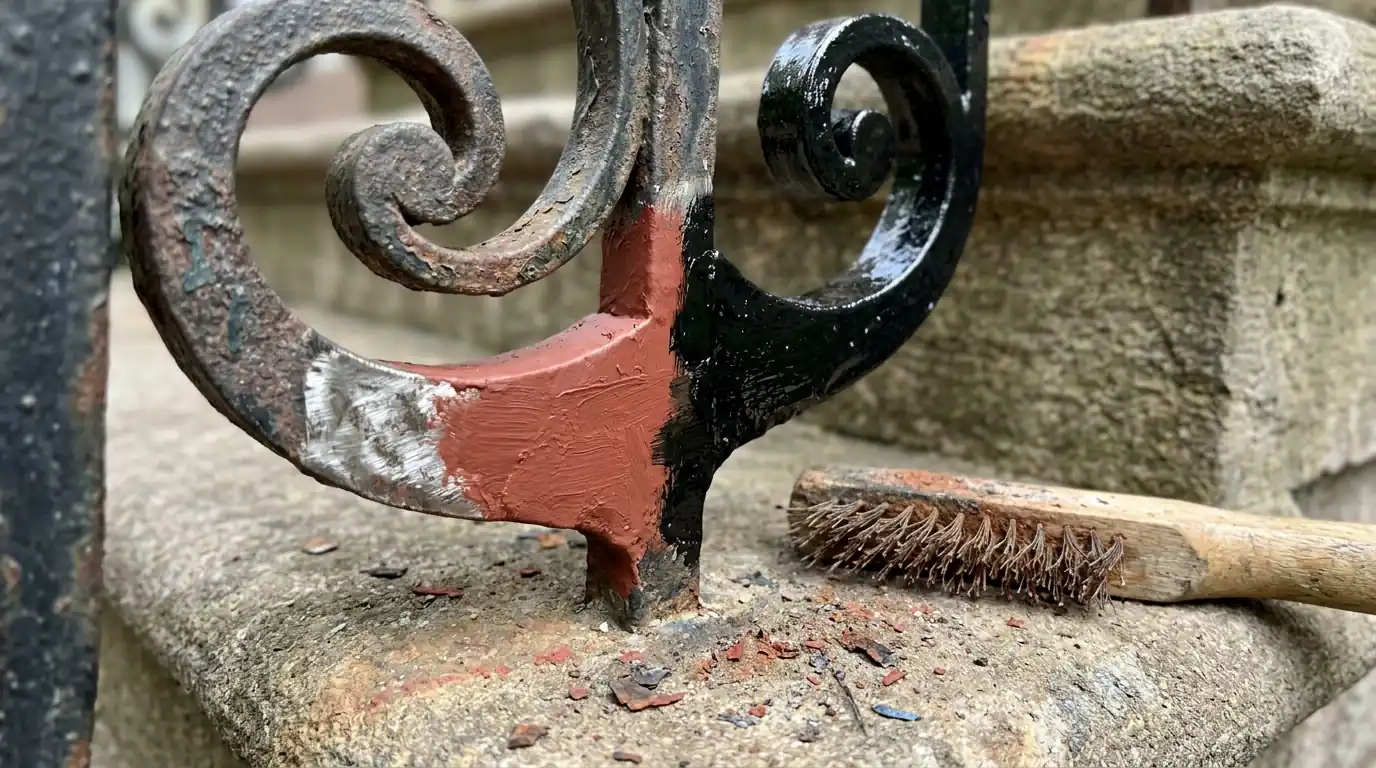
Rust takes up far more room than the iron it came from. When it grows inside the anchor hole where a post meets a stone or concrete step, it can split the stone or pop the concrete around it. We clean those bases as deeply as we can reach, prime them heavily, and seal the joint so water sheds away instead of sitting in the socket. Badly heaved anchors need resetting before paint, and we'll point that out at the walkthrough.
Satin black is the default on most stoop and porch railings, and it hides minor surface texture well. On Victorian twins in West Chester or Doylestown, deep green, dark bronze or a near-black brown can tie the railing to the shutters and trim. Gloss looks sharp but shows every pit. If you live in a historic district, check with your borough before changing the color of a street-facing railing, since some boroughs ask about exterior changes.
Raised blisters in the paint mean rust is growing underneath. Popping one usually shows orange flakes and bare, pitted iron below.
Rust bleeding onto stone, concrete or brick steps below the railing means the coating has failed somewhere above, often at a joint or weld.
A crack spreading from a railing post anchor often comes from rust expanding inside the hole. Catching it early limits the damage to the step.
Paint coming off newer galvanized steel in strips usually means the wrong primer was used underneath. It needs a full strip and the correct primer.
Movement at the base often traces back to rusted anchors. We'll flag it, since paint alone won't fix a railing that's working loose.
Faded black that leaves a gray smudge on your hand is worn thin and ready for a recoat before rust gets through to the iron.
We figure out whether the railing is wrought or cast iron, mild steel, galvanized or powder-coated, test old paint for lead, and check each post for movement at its base.
Tarps go over stone and concrete steps, porch floors and nearby beds, and we tape off siding, stucco and door trim wherever the railing attaches.
Wire wheels, flap discs and hand brushes take off loose rust and paint. Lead coatings are misted and scraped by hand, with chips collected as we go.
We rinse away road salt and dust with clean water, wipe the metal down, and let it dry completely so no moisture gets trapped under the primer.
Bare iron gets a rust-inhibitive primer before the day ends, so flash rust never gets a start. Galvanized and powder-coated surfaces get their matched bonding primers.
We brush two full coats, paying extra attention to edges, welds and the undersides of rails, where thin paint fails first.
Railing prices depend on length, how ornate the ironwork is, how far rust has taken hold and whether lead paint changes the setup. A straight pair of stoop railings is a half-day job. A long Victorian porch railing with cast details can take several days. The figures below are 2026 ranges seen on homes in Exton and the nearby boroughs.
| Job | Typical range |
|---|---|
| Pair of stoop railings, standard | $395 to $845 |
| Ornate cast iron stoop railings | $665 to $1,390 |
| Porch railing, per linear foot | $29 to $54 |
| Scrolled iron porch column, each | $135 to $285 |
| Galvanized railing, strip and correct primer | $485 to $1,135 |
Planning ranges for 2026, not quotes. The written price comes from a walkthrough. See every service side by side on the painting costs page.
We take on iron railing painting in these towns across Chester, Delaware, Montgomery and Bucks counties. ZIP codes shown for each.
With proper rust removal and two coats of enamel, most railings go four to six years before needing touch-up, and longer on covered porches. Railings beside driveways or sidewalks that get heavy salting wear faster, especially at the post bases. A quick spring check for blisters and chips makes the next repaint much simpler.
Rarely. Most railings are set into stone or concrete, and pulling them out risks cracking the steps. We paint them in place and protect everything around them. If a section is already loose or broken, it may come off briefly for repair, but that's decided case by case after we look at the anchors.
Many metal enamels need air and surface temperatures above 40 or 50 degrees, and the metal has to stay above the dew point while paint dries. Iron gets colder than the air around it, so we check surface temperature with a thermometer. Late fall and early spring days often work if we start after the morning dew burns off.
Peeling in large sheets usually points to galvanized steel coated with the wrong primer, or paint applied over leftover rust and salt. Either way, the bond was never there. We strip the loose coating, prepare the metal correctly for its type, and use a primer designed for it, which is the only lasting fix.
Yes, those decorative scrolled columns are some of the most common iron we paint. Rust usually starts at the base plate and the scroll joints. We clean, prime and paint them in place, check that the top and bottom plates are still fastened, and protect the slab while we work. Adding porch floor painting at the same visit saves a second setup.
Your front door gets touched, kicked and baked in afternoon sun more than any other painted surface on the house. We take the hardware off, fix the...
Wraparound farmhouse porches, borough front porches and the concrete stoops of 1950s colonials all wear out underfoot first. We sand or grind back to...
If your house was built before 1978, there's a good chance some of its paint contains lead. That covers stone farmhouses, borough twins and many...
We repaint the outside of homes around Exton, from fieldstone farmhouses with wood trim to 1990s colonials wrapped in cedar, stucco and vinyl. Every...
Fences around Exton run from short picket runs in front of borough homes to hundreds of feet of split-rail and board fence on larger lots. We clean,...
Call any time. We will ask a few questions and set up a walkthrough at your home.