Exterior House Painting
We repaint the outside of homes around Exton, from fieldstone farmhouses with wood trim to 1990s colonials wrapped in cedar, stucco and vinyl. Every...
Wood siding covers a lot of houses around Exton, from cedar clapboard on 1980s colonials to old pine siding on farmhouses and the shingled gables of Victorian twins in Phoenixville and West Chester. We repaint it with careful scraping, tannin-blocking primer and finishes that flex as the wood moves.
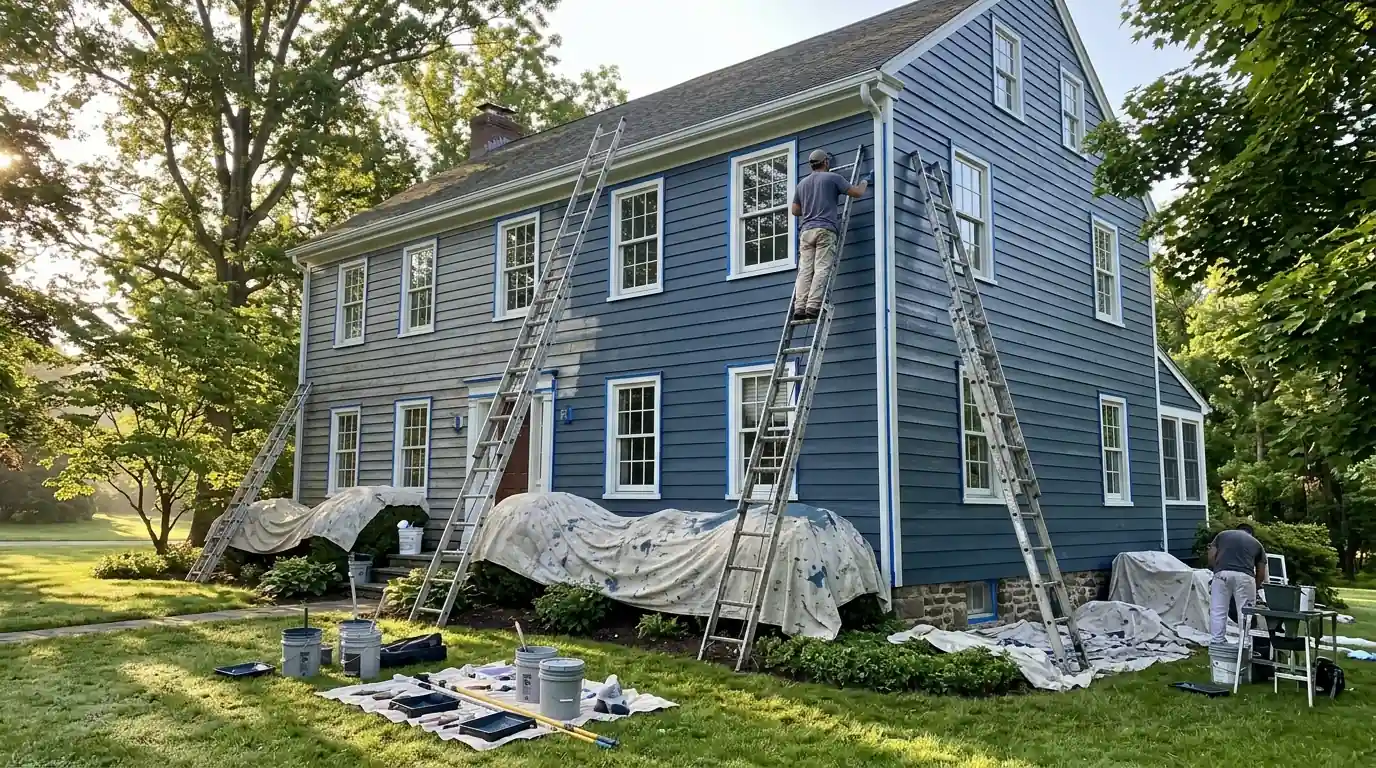
Painting wood siding means washing, scraping loose paint, sanding edges, repairing or replacing rotted boards, priming bare wood, sealing only the joints that should be sealed, then two acrylic topcoats. Around Exton and Chester County, a two-story cedar-sided colonial usually runs $8,640 to $16,970. A Victorian twin half with shingle gables in a borough lands around $5,860 to $11,270.
Wood swells through humid Chester County summers and shrinks through dry, heated winters. Paint on siding has to flex with that every year. When it can't, it cracks along the grain, water gets into the crack and the next season lifts it further. That's why siding paint fails at board edges and along the bottom lap first, long before the flat face of each board looks bad.
Cedar brings its own quirks. It resists rot naturally, which is why so many builders used it on colonials and contemporaries in the 1980s and 1990s, but its tannins bleed through light paint as brown streaks. Older farmhouse siding is often pine or poplar carrying layers of oil paint under newer latex. Each one needs a different primer, so we figure out what's on your house before choosing products.
Good siding prep is slow hand work. We scrape with sharp carbide blades, then feather the edges of remaining paint with sanders hooked to HEPA vacuums so the next coat doesn't show ridges. We never use open-flame torches on siding. On homes built before 1978, every old layer is treated as lead-bearing, with ground sheeting and daily cleanup. Our lead-safe setup explains how that works around gardens and play areas.
Siding that has been bare and gray for a season needs sanding back to fresh fibers. Sun breaks down the surface of exposed wood, and primer over that weak layer peels away in sheets within a few years. A light sanding takes time, but it's the difference between a paint job that lasts a decade and one that starts flaking by the third summer.
Cedar and redwood contain water-soluble tannins that travel to the surface and stain light colors, especially when rain arrives soon after painting. A standard acrylic primer won't hold them back. We spot-prime knots and bare cedar with a stain-blocking oil or alkyd primer, or a waterborne primer made for tannin blocking, and let it cure fully. Cedar shakes on gables get the same treatment before two acrylic topcoats go on.
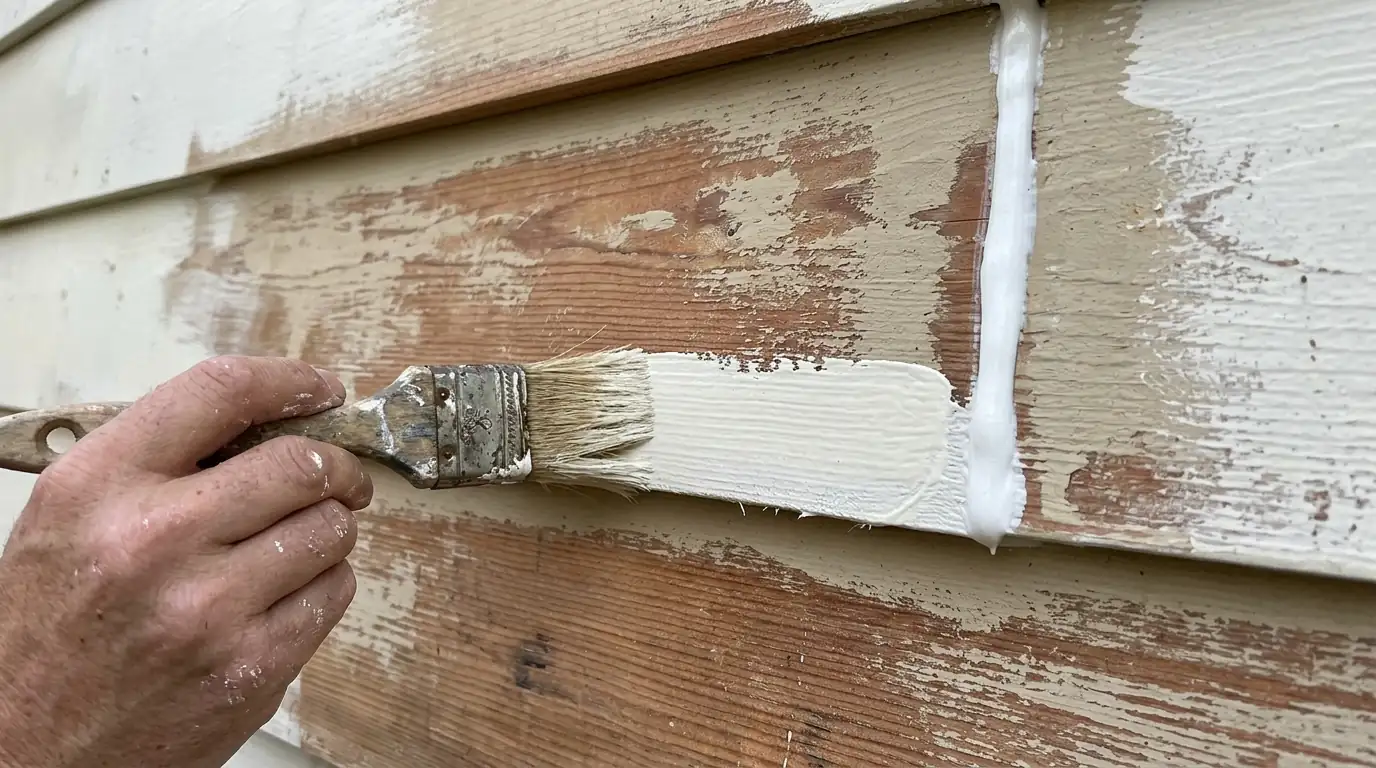
Caulk seals vertical butt joints, gaps at corner boards and the seams around window and door casings. It should never fill the horizontal laps between clapboards. Those laps let the siding drain and dry, and sealing them traps moisture inside the wall. Every season we find houses where an earlier painter caulked every lap and the paint above is blistering because of it.
Rot on wood siding starts where water sits: the bottom course near mulch beds, below window sills, behind downspouts and wherever a deck meets the wall. We probe those areas, cut out soft boards and replace them with matching profiles, back-primed on all sides before they go up. Smaller soft spots get consolidant and epoxy filler. Bigger fixes are covered on our wood rot repair page.
Thin cracks running with the boards show the paint has gone stiff and can no longer move with the wood through each season.
Tan or brown bleeding on cedar after rain means tannins are coming through, a sign the last painter skipped a stain-blocking primer.
Exposed boards turn gray within months, and that sun-weakened surface has to be sanded back before it can hold primer and paint again.
Bubbles in siding paint outside a bathroom or laundry room usually mean interior moisture is pushing outward through the wall.
Black spotting on north walls under trees grows on the paint film and needs treatment, or it will reappear through the fresh coat.
Bottom courses that give under a screwdriver are rotting from splash and mulch contact, and they need repair before any painting.
We check each side for rot, failed caulk, moisture sources and peeling patterns, and mark boards that need repair before we price the paint work.
A gentle wash with a mildew cleaner removes dirt and growth. The siding then dries for at least two days so primer can soak into the grain.
Loose paint comes off by hand. Edges are feathered with HEPA sanders, and weathered gray wood is sanded back to sound fibers.
Rotted sections get epoxy filler or new boards milled to match, primed on every face before installation so moisture can't wick in from behind.
Bare wood, knots and repairs get primer the same day. Joints that should be sealed get flexible caulk, while laps stay open to drain.
We brush the underside edge of every board, where water hangs longest, then roll and brush the faces with two coats of acrylic finish.
Wood siding takes more prep per square foot than any other exterior surface, mostly scraping, sanding and spot priming. These 2026 ranges reflect homes around Exton and across Chester County. A house with sound paint costs far less than one with years of peeling and rot. We confirm the number after walking every side of your house with you.
| Job | Typical range |
|---|---|
| Two-story cedar-sided colonial, full siding | $8,640 to $16,970 |
| Victorian borough twin half with shingle gables | $5,860 to $11,270 |
| Farmhouse clapboard, one side | $1,970 to $4,380 |
| Cedar shake gable, prime and two coats | $745 to $1,860 |
| Board replacement, per run | $185 to $465 |
Planning ranges for 2026, not quotes. The written price comes from a walkthrough. See every service side by side on the painting costs page.
We take on wood siding painting in these towns across Chester, Delaware, Montgomery and Bucks counties. ZIP codes shown for each.
Yes, once the old stain has weathered and the wood is clean and dry. We sand glossy areas and use a stain-blocking primer so tannins don't bleed through. Curled or split shakes should be replaced first, since paint won't flatten them or stop water getting behind.
One-sided peeling usually follows sun or moisture. South and west walls bake and crack the film faster. A wall outside a bathroom, kitchen or laundry may blister from interior moisture. We look at both before choosing primer and repairs for that side.
With proper prep and two acrylic coats, most walls hold seven to ten years. Sunny, exposed sides may need attention sooner. Washing the siding every couple of years and fixing split caulk early stretches the time between full repaints noticeably.
That's a bigger decision about cost and how the house looks. On older farmhouses and borough Victorians, original wood is usually worth keeping, and paint protects it well. If part of your house already has vinyl, see our page on painting vinyl siding.
We sometimes spray primer on large open walls and back-brush it into the wood. Finish coats are mostly brushed and rolled, which works paint into the grain and laps better than spray alone and keeps overspray off cars, decks and neighbors' houses.
We repaint the outside of homes around Exton, from fieldstone farmhouses with wood trim to 1990s colonials wrapped in cedar, stucco and vinyl. Every...
Rot on Chester County homes tends to start where water sits: window sills on old farmhouses, porch post bases, the bottoms of door jambs and trim on...
If your house was built before 1978, there's a good chance some of its paint contains lead. That covers stone farmhouses, borough twins and many...
Green streaks on the north side of a vinyl-sided house, black mildew on a cedar deck, a gray film on fieldstone: Chester County's humid summers grow...
Bank barns, carriage houses, wood sheds and detached garages are part of what makes Chester County properties look the way they do. We scrape them...
Call any time. We will ask a few questions and set up a walkthrough at your home.