Iron Railing Painting
Iron railings on borough stoops, Victorian porches and 1960s ranch entries all fail the same way: rust starts at a chip, creeps under the paint and...
Wraparound farmhouse porches, borough front porches and the concrete stoops of 1950s colonials all wear out underfoot first. We sand or grind back to a sound surface, seal board ends and seams, and lay down two coats of porch enamel with grit that holds up through snow, salt and July sun.
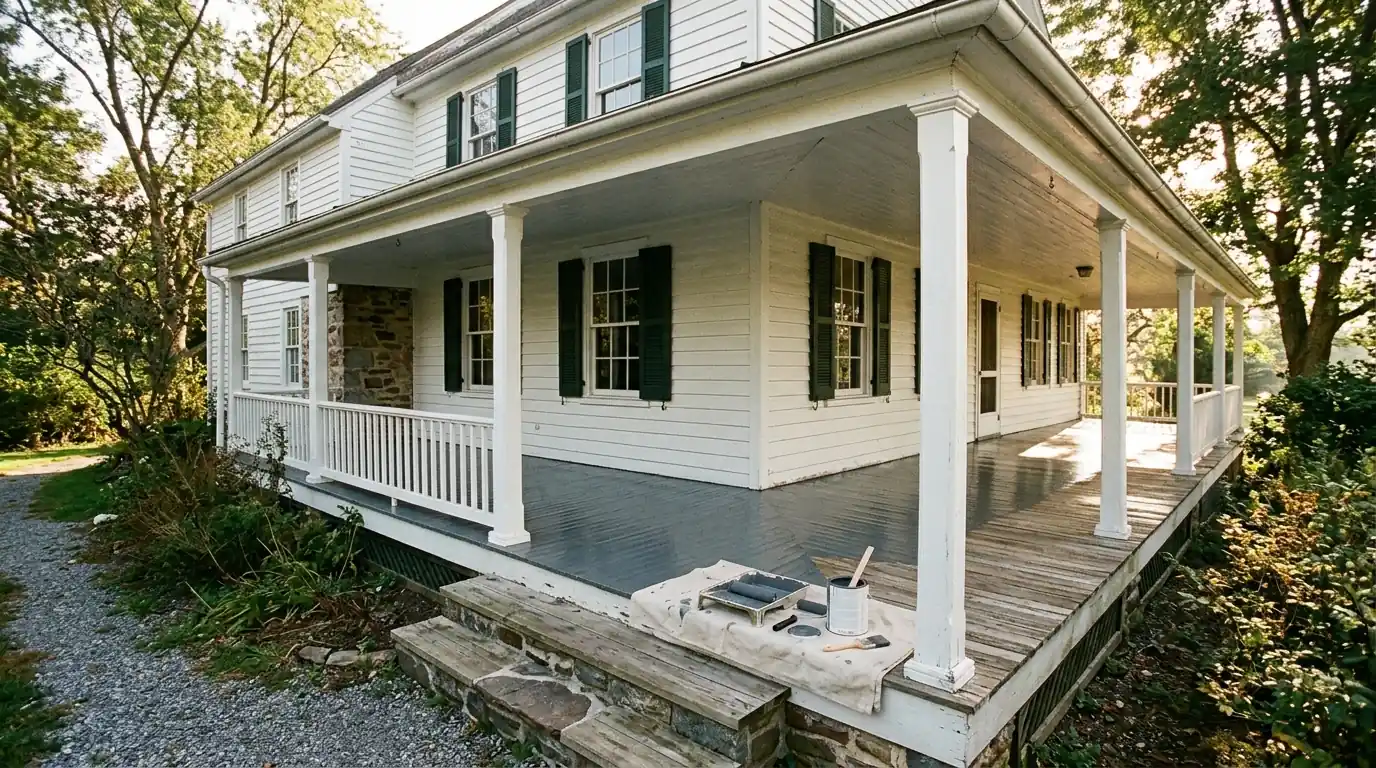
We scrape and sand wood porch boards or grind and etch concrete, prime bare spots, seal board ends, then roll and brush two coats of exterior porch and floor enamel with fine grit in the last coat. Around Exton and Chester County, a covered front porch floor typically runs $715 to $1,385, and a farmhouse wraparound costs $1,865 to $3,540.
The long porches on Chester County farmhouses and the deep front porches on Victorian homes in Downingtown, West Chester and Doylestown are almost always tongue-and-groove wood, often fir or yellow pine. They're beautiful, but every board end, seam and nail hole is a place for water to get in. Paint gives up first at the outer edge where rain blows in, at the steps, and along the path everyone walks to the door.
Concrete porches and stoops on 1950s and 1960s colonials have their own problems. Paint lifts when moisture rises through the slab, and winter salt leaves a white crust under the coating. Homes from the 2000s may have a painted wood porch paired with composite steps. We look at what's underneath before choosing a product, because the wrong enamel on the wrong surface peels within a year.
Wood porch floors move with every change in humidity, and boards cup when the underside stays damp. Before painting, we check that the skirting lets air reach underneath. Then we sand off loose and chalky paint, set raised nails, and prime bare wood with an oil-based primer worked into seams and end grain. Replacement boards get primed on all six sides before installation so they don't pull moisture and cup. Spongy boards near the steps get flagged for rot repair first.
A slab can look dry and still push moisture up from below. We tape a square of clear plastic to the concrete and leave it overnight. Droplets or a dark patch underneath mean paint will blister, and we'd rather tell you that than coat it anyway. Dry slabs get scraped, degreased, and etched or ground until the surface feels like medium sandpaper, which gives the enamel something to grip.
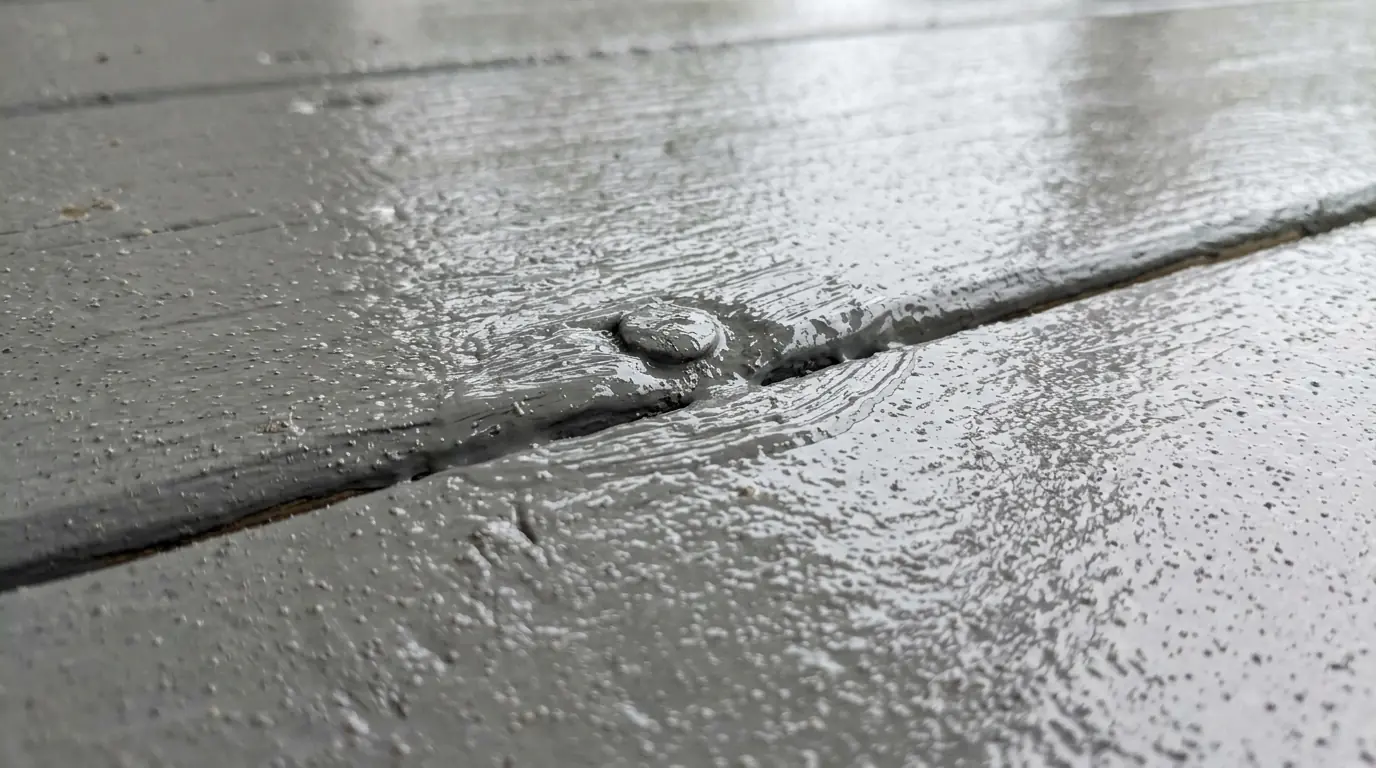
A smooth enamel turns slick when it's wet or frosty. We mix or broadcast fine anti-slip grit into the final coat on steps and walking paths, which makes a real difference on north-facing porches that hold winter moisture. Satin and low-luster finishes hide scuffs better than gloss. Traditional porch grays suit most farmhouses and Victorians, while lighter tans stay cooler underfoot in summer. Many owners repaint the porch ceiling a pale blue at the same time.
Porch enamel needs surface temperatures above 50 degrees and a dry forecast for at least a day, which around Exton usually means May through early October. Our post on picking the right painting months explains the timing in more depth. You can walk on the floor carefully after about a day. Chairs and planters should stay off for three days, and rugs or mats for a week, so nothing sticks or leaves rings.
Peeling that follows the gaps between boards shows water getting into the joints and under the paint film, usually working in from the porch edge.
A bare or gray strip where everyone walks means the enamel has worn through, and that wood now soaks up water with every rain.
Efflorescence and salt residue under the paint push it off the slab. It needs grinding and cleaning before any new coating will stick.
Boards curling at the edges or giving underfoot point to moisture from below or rot. Those get fixed before we paint anything.
If the porch steps feel slick when wet or frosty, the next coat should include anti-slip grit, especially on steps that stay shaded.
Several shades of gray from past touch-ups make a porch look worn even when the boards are sound. One full recoat evens it all out.
We check boards for rot and cupping, look at airflow under the porch, identify the old coating, and run a plastic-sheet moisture test on any concrete slab.
Furniture comes off, loose paint is scraped, and wood is sanded to remove chalky and failing coating, using lead-safe methods on older porches.
Concrete is degreased, ground where it's peeling and etched elsewhere, so the whole surface has a texture the primer can grab onto.
Popped nails are set, soft boards are replaced and primed on all sides, and bare wood or concrete gets the right primer before any topcoat.
We cut in along posts and siding by brush and roll the open floor, adding fine grit to the final coat on steps and traffic paths.
We rope off the porch, explain when you can use it again, and leave a labeled can of the exact color for later touch-ups.
Porch floor pricing depends mainly on square footage, how much paint is failing, whether the surface is wood or concrete, and how many steps are involved. A sound porch that just needs a scuff and recoat is quick. One with peeling paint across every seam takes much longer. The ranges below reflect 2026 porch work around Exton, and your number comes from measuring your porch.
| Job | Typical range |
|---|---|
| Concrete front stoop and steps | $345 to $685 |
| Covered front porch floor, wood | $715 to $1,385 |
| Concrete porch with grinding | $635 to $1,215 |
| Farmhouse wraparound porch, wood | $1,865 to $3,540 |
| Replace and prime a porch board | $49 to $91 each |
| Porch ceiling repaint, added | $385 to $795 |
Planning ranges for 2026, not quotes. The written price comes from a walkthrough. See every service side by side on the painting costs page.
We take on porch floor painting in these towns across Chester, Delaware, Montgomery and Bucks counties. ZIP codes shown for each.
Not directly. Clear sealers are designed to keep things from soaking in, so paint has nothing to hold onto. We test with a few drops of water. If they bead, the sealer is still active and has to be stripped or ground off before any primer goes down on the slab.
A covered wood porch with good prep typically looks good for three to five years before the traffic path needs a recoat. Uncovered steps and porches that take full sun and snow wear sooner. Touching up the worn path every couple of years stretches the life of the whole floor.
Usually not. Traditional porch floors are a medium or dark gray, sometimes a muted green or brown, so dirt and scuffs don't show. Trim is often white or cream, which would look dirty on a floor within weeks. We'll suggest floor colors that sit well with your siding, stone and front door.
Not for long. Hairline cracks may disappear at first, but they tend to show again as the slab moves through winter. We fill small cracks with a flexible patching material before coating. Wide or shifting cracks point to a slab problem that paint can't solve, and we'll tell you so.
Composite decking isn't meant to be painted, and most makers advise against it. We can clean composite boards and paint or stain the wood trim, skirting and rails around them, which is common on 2000s homes where the porch mixes materials.
Iron railings on borough stoops, Victorian porches and 1960s ranch entries all fail the same way: rust starts at a chip, creeps under the paint and...
Rot on Chester County homes tends to start where water sits: window sills on old farmhouses, porch post bases, the bottoms of door jambs and trim on...
Your front door gets touched, kicked and baked in afternoon sun more than any other painted surface on the house. We take the hardware off, fix the...
We repaint the outside of homes around Exton, from fieldstone farmhouses with wood trim to 1990s colonials wrapped in cedar, stucco and vinyl. Every...
Many homes built around Exton in the 1990s and 2000s came with big pressure-treated decks off the kitchen, often a full story up with long stairs. We...
Call any time. We will ask a few questions and set up a walkthrough at your home.